

On Valentine’s Day 1966, Idaho Gov. Bob Smylie called a special session of the state Legislature to deal, primarily, with reapportioning the Idaho Senate to comply with the U.S. Supreme Court’s one-man-one-vote requirement. Back then, there was a senator for each of the state’s 44 counties, and the courts had ruled the arrangement unconstitutional.
So when Smylie gathered legislators under the dome, he was clear about priorities: reapportionment was the reason they were there. Other matters requiring attention while lawmakers were in town — purchasing real estate around the Statehouse, development of Farragut State Park — were secondary. Toward the end of his remarks, almost in passing, he mentioned the need for lawmakers to consider “adjustments to the public assistance law if we are to make its full benefits available to our people.”
What adjustments? The year prior, Congress had passed President Lyndon Johnson’s Great Society legislation. Among its provisions, a program we now call Medicaid. States were free to adopt, or not adopt, the program. If they did, the federal government would pick up the majority of the bill to cover the health expenses of the poor and disabled enrolled in the program.
In the days and weeks that followed, the Legislature adopted those public assistance changes with little apparent deliberation. The House voted 68-7 in favor of House Bill 14. The Senate voted 39-1. The newspapers of the time say little else about the debate.
It is worth sitting with that for a moment. Because, as we know now, Medicaid would eventually become the largest program in all of state government — larger than public schools when state and federal funds are totaled. It serves roughly one in five Idahoans today. It shapes how hospitals are built, how physicians practice, how billing for services is done, how nursing homes operate, and how mental health services are delivered across the state.
None of that was contemplated in 1966. You would not imagine it from the text of Smylie’s speech, nor from the way newspapers covered the bill’s passage. The program was adopted not through serious deliberation but as an administrative footnote to a session called for an entirely different purpose.
As the economist Thomas Sowell has observed, there are no solutions — only tradeoffs. Sixty years of Medicaid participation has come with real ones, and Idaho’s policymakers have rarely named them. Not at the outset. Not in the years that followed. I’ll examine these tradeoffs more precisely in the coming weeks. But for now, consider what is not considered: What did we give up when Idaho lawmakers and its governor 60 years ago agreed to participate in Medicaid.
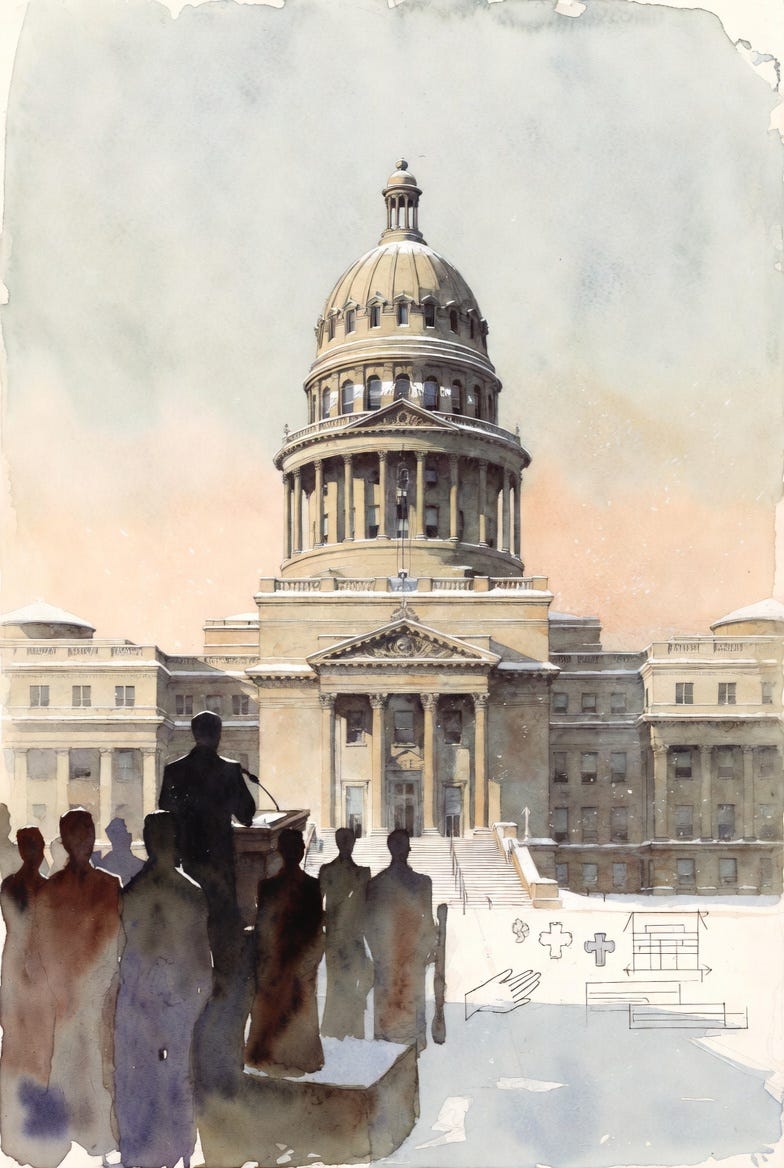
For one, politicians elected generations ago chose for us how we express compassion for the medically indigent. They decided that centralized charity administered through a bureaucracy was better than ones that friends, neighbors, churches, and community organizations would devise. And we’ve never looked back. And subsequent generations were never asked if they could do it better — or should even try.
Where Medicaid didn’t cover the population, county governments were enlisted to offer “indigent” services, overseen by the Board of Commissioners. Later, again for services not provided by state or local government, compassion was again transferred to the state with Medicaid expansion in 2018 via voter initiative. Still later, in 2024, lawmakers added women up to 12 months after pregnancy to the program.
Some will argue that the existing system’s centralization has provided coverage for people in need, coverage that they’d otherwise be unable to afford. But coverage isn’t care. Moreover, the centralized system leaves a lot of people behind. The mere assumption that Medicaid is covering people makes people not question the reality that numerous people on Medicaid find its coverages lacking.
This isn’t a question only of dollars and cents. It’s not just a function of how well we tend to the state budget or how government hires employees to administer a program. It’s a question of the very essence of our humanity, our willingness to pause and see if we’re doing well by our neighbors. In accepting this program and administrating it for 60 years, without question and reflection, have we prioritized compassion, or outsourced it to a bureaucracy?
The dual-sovereignty structure of American federalism exists precisely so that states can chart their own course when federal programming does not serve their people well. Idaho has that authority. The state’s political apparatus has simply never exercised it — or even seriously examined whether it should.